300 Junk Journal Prompts for Canva
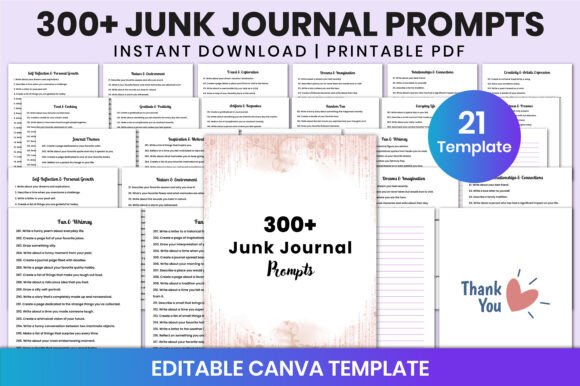
If you’ve ever flipped through a handmade junk journal—its pages layered with vintage ledger scraps, faded floral paper, torn book pages, and handwritten notes—you know the quiet magic of tactile storytelling. 300 Junk Journal Prompts for Canva brings that same spirit into your digital workflow—not as a static template, but as a living, editable creative engine built for makers who value authenticity over polish.
This isn’t just a list of prompts. It’s a 21-page, print-ready interior designed specifically for KDP creators, crafters, and small publishers who want to launch a high-quality junk journal without reinventing the wheel. Every prompt is hand-curated to spark reflection, play, memory-keeping, or whimsy—think “Describe a smell from your childhood kitchen” or “Paste something blue that reminds you of calm.” The layout leans into the junk journal aesthetic: intentional imperfection, gentle asymmetry, subtle texture overlays, and generous white space that invites collage, stamping, or handwritten additions.
The Canva link gives you full design control—you can swap fonts, adjust colors, add your own scanned ephemera, or reformat pages for different binding styles. The included PDFs are CMYK, 300 DPI, and sized at 8.5 × 11 inches with no bleed—so they’re production-ready for KDP or local print shops. No hidden layers, no locked elements. Just clean, flexible assets that respect your time and creative voice.
Why These Prompts Work Where Others Fall Short
Most prompt collections lean heavily into either therapy-journaling (deep self-inquiry) or craft-only (cut-and-paste instructions). 300 Junk Journal Prompts for Canva lives in the fertile middle ground: it supports emotional resonance *and* material experimentation. Each prompt is written to be open-ended yet grounded—short enough to fit on a tiny tag, rich enough to anchor a two-page spread.
You’ll find prompts organized by mood and function: nostalgic, sensory, playful, reflective, seasonal, and collaborative. Some invite writing; others suggest visual responses—like “Glue down three textures that feel like safety” or “Trace the outline of a found object and fill it with words.” That duality makes them equally useful for solo journaling, classroom workshops, or co-created zines.
Designed for Real Creative Workflows
This resource was built by someone who’s shipped junk journals on KDP, taught mixed-media classes, and spent years optimizing Canva files for print accuracy. That shows in the details:
- No font dependency: All text is editable in Canva—no need to install external typefaces. The default styling uses accessible, low-contrast sans serif pairings that stay legible when printed on textured paper or copied via home printer.
- KDP-optimized spacing: Margins account for common binding shifts. Page numbers sit safely within trim zones, and prompt boxes avoid the gutter where staples or perfect binding might obscure content.
- Texture-aware design: Backgrounds use subtle, low-opacity overlays—not heavy grunge filters—so your scanned tickets, lace scans, or watercolor swatches retain their character when layered on top.
It’s not about making things look “vintage.” It’s about building structure that gets out of the way so your voice—and your materials—take center stage.
How to Use This Beyond the Obvious
Yes, you can drop this straight into a KDP junk journal. But its real flexibility shines in hybrid workflows:
- For educators: Print single prompts on cardstock, laminate them, and use them as rotating station prompts in art or ELA classrooms—especially effective for neurodiverse learners who benefit from multimodal expression.
- For content creators: Pull prompts into Instagram carousels or Pinterest pins with your own photos or process videos. “Prompt #47: What would your ideal Tuesday morning sound like?” becomes shareable, relatable, and deeply human.
- For small publishers: Mix and match pages across multiple journal titles—swap covers, rearrange sections, or combine prompts with original illustrations to create themed editions (e.g., “300 Nature Junk Journal Prompts” or “300 Travel Junk Journal Prompts”).
And because the Canva file is fully editable, you’re never locked into one version. Update wording for cultural relevance, translate prompts for bilingual editions, or adapt tone for teen vs. adult audiences—all without redesigning from scratch.
Practical Notes Before You Begin
If you’re planning to publish on KDP, keep these in mind:
- Licensing is clear and commercial-use friendly: You’re free to use these prompts in physical and digital products you sell—including editable Canva versions, if you add meaningful original design or instruction.
- Test print first: While the PDFs are KDP-ready, always order a physical proof. Texture-heavy papers can mute fine lines or light gray tones—adjust contrast in Canva if needed before final upload.
- Pair thoughtfully: Since the prompts themselves aren’t tied to a specific typeface, choose fonts that honor the junk journal ethos—slightly irregular serifs, warm monoline sans serifs, or restrained handwritten styles. Avoid ultra-thin weights or tightly spaced display fonts—they’ll vanish when photocopied or printed on newsprint.
One last note: this collection doesn’t try to be everything. It won’t teach you how to distress paper or source antique maps. But it *will* give you 300 honest, tested starting points—each one calibrated to invite curiosity, not overwhelm. That’s rare. And it’s why so many designers, bloggers, and indie publishers come back to 300 Junk Journal Prompts for Canva when they need clarity, consistency, and creative momentum—without sacrificing soul.
If you like this resource—and especially if you plan to build more than one journal—hit follow on the profile. New updates include seasonal prompt expansions, printable sticker sheets, and companion Canva kits for cover design and marketing assets. All made with the same attention to craft, clarity, and quiet intention.