Canva Gratitude Journal, KDP Interior
A Canva Gratitude Journal, KDP Interior isn’t just another printable planner—it’s a production-ready workflow asset designed for creators who build, sell, and use journals as tools—not just products. It bridges the gap between personal reflection and professional publishing: fully editable in Canva, pre-verified for Kindle Direct Publishing, and structured to support both daily intentionality and scalable output. Whether you’re launching your first gratitude journal on Amazon, refining a client’s custom planner, or building a consistent self-reflection habit, this interior template delivers consistency without rigidity.
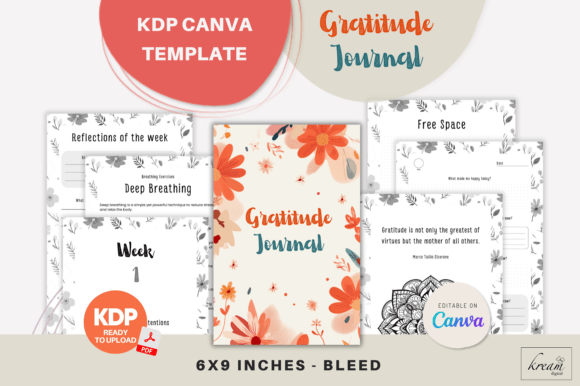
At its core, the Canva Gratitude Journal, KDP Interior is a 126-page, 6×9-inch, bleed-enabled PDF built for real-world use. Every page is editable in Canva—text, fonts, colors, spacing, background imagery, even layout grids. That means no static PDFs locking you into one aesthetic. You’re not stuck with preset quotes or fixed prompts. Instead, you control tone, voice, and visual rhythm across all 126 pages—including 10 weekly introduction pages with customizable prompts, 10 relaxation spreads, 10 breathing exercise guides, and dedicated spaces for weekly reflection, daily gratitude logging, creative freeform writing, and even a “Letter to Me” page for future-self dialogue.
Each week features a distinct background—subtle textures, soft gradients, or minimalist line art—designed to support mood shifts without overwhelming focus. These aren’t decorative afterthoughts. They’re functional anchors: a visual cue that signals transition, supports emotional regulation, and reinforces weekly pacing. For educators using this in student wellness programs, the changing backgrounds help learners distinguish timeframes. For entrepreneurs reviewing quarterly goals, they offer psychological separation between planning cycles. The design serves process—not just appearance.
This template integrates cleanly into existing workflows because it doesn’t ask you to replace your tools—it extends them. If you use Notion for task management, you can pull weekly priorities from your dashboard and paste them directly into the “Weekly Introduction” section. If you run a coaching business and send clients reflection prompts via email, those same prompts can be embedded into the “Reflection of the Week” page—then exported as a branded PDF for download. If you’re a KDP publisher batching multiple journals, you reuse the same Canva file, swap colors and copy, adjust cover copy, and generate a new interior in under 20 minutes—no reformatting, no bleed errors, no last-minute KDP upload failures.
Preparation matters—and this template reduces friction at every stage. The presentation page sets expectations before users open the journal. The “Keywords” page isn’t filler; it’s a quiet prompt to define what gratitude looks like *for this person*, right now—“patience,” “boundaries,” “stillness,” “clarity.” That single page helps ground entries and discourages generic responses. Likewise, the “Free Space for Creativity” page isn’t blank—it’s intentionally unstructured, inviting sketching, mind mapping, or collage alongside written reflection. That flexibility supports neurodiverse users, visual thinkers, and those rebuilding reflective habits after burnout.
Usability is baked in—not added on. All text boxes are properly anchored (no floating elements), margins respect KDP’s 0.25″ inner margin requirement, and bleed extends cleanly to 0.125″ beyond trim. Fonts are web-safe and embeddable. There are no hidden layers or locked objects. When you duplicate a page in Canva, the layout stays intact. When you change a color palette, it updates consistently across all editable elements—not just headers, but checkboxes, icons, and line dividers. That level of polish saves hours during quality control, especially when scaling across multiple SKUs or language versions.
Consistency doesn’t mean uniformity. Because each weekly spread has its own background, you can align visuals with seasonal themes—warm tones for autumn weeks, airy blues for spring—without redesigning layouts. You can also vary prompt depth: one week might ask “What surprised me this week?” while another asks “Where did I protect my energy?” That variation keeps the journal responsive, not repetitive. For freelancers tracking creative projects, pairing the “Daily Gratitude Journal Page” with a simple time log (added manually or via Canva’s table tool) creates an informal impact tracker: not just *what* got done, but *how it felt* to do it.
Long-term use works because the structure supports evolution. The “Letter to Me” page isn’t meant for one-time use. Revisit it quarterly. Compare past letters to current ones. Notice shifts in language, tone, priority. That kind of longitudinal insight only emerges when the format remains stable enough to track—but flexible enough to adapt. Similarly, the breathing exercise pages include space to note date, duration, and immediate physical response. Over time, that builds embodied data—not abstract goals, but measurable patterns in nervous system regulation.
Compatibility extends beyond Canva and KDP. Export the file as a high-res PDF for print-on-demand partners like IngramSpark or BookBaby. Pull individual pages into Google Slides for virtual workshops. Convert the “Relax Pages” into standalone Instagram carousels for audience engagement. Embed the “Breathing Exercises” into a Notion template library for team wellness initiatives. Because the source file lives in Canva, repurposing is frictionless—not a conversion headache.
Efficiency comes from intelligent defaults—not constraints. The 130-page paperback cover template included with the Canva Gratitude Journal, KDP Interior matches the interior’s dimensions, bleed, and spine width (calculated precisely for 126 interior pages + cover). No guesswork. No manual spine math. Just drag your title, author name, and barcode into place, export, and upload. That precision eliminates the most common KDP rejection reason for new publishers: formatting mismatches between interior and cover.
For marketers building lead magnets, this interior becomes a high-value opt-in—branded, polished, and instantly usable. For bloggers launching digital products, it’s a natural upsell to a paid course or coaching package: “Get the journal used in Module 3.” For small business owners documenting company values, the “Gratitude Journal Page” transforms into a team appreciation log—printed monthly and displayed in shared workspaces. The utility scales with your intent.
Quality control is simplified because everything is editable in one place. Need to update copyright year? Change it once—in the master page—and it propagates across all instances. Want to adjust line height for better readability on printed copies? Do it globally, not page by page. Prefer a serif font for prompts and sans-serif for journal lines? Apply it systemically. This isn’t about making things look “pretty.” It’s about building reliability into the editing layer so your output stays professional, even when you’re iterating fast.
Finally, integration isn’t about adding more tools—it’s about reducing cognitive load. When your gratitude practice, your publishing pipeline, and your personal review cycle all flow from the same editable source, decisions become faster and more aligned. You’re not toggling between apps to make a journal “work.” You’re using one asset to serve multiple outcomes—self-awareness, product creation, client delivery, audience growth—all without sacrificing fidelity or function.
The Canva Gratitude Journal, KDP Interior fits where reflection meets execution. It’s ready before your first draft, active during your daily routine, and useful long after your initial goals shift. It doesn’t assume your pace, your priorities, or your process. It provides scaffolding—then gets out of the way.