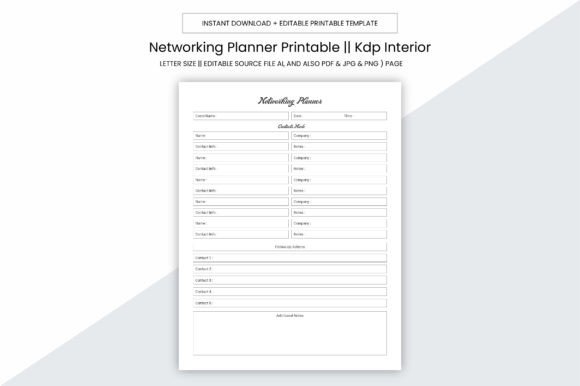
Networking Planner Kdp Interior
Imagine opening a planner that doesn’t just track meetings—but actively strengthens your professional relationships, sharpens your outreach strategy, and grows with your business. The Networking Planner Kdp Interior is built for that purpose: a thoughtfully structured, print-ready interior designed not as filler, but as functional infrastructure for creators, entrepreneurs, educators, and small business owners who value intention over inertia.
At 8.5 x 11 inches—standard letter size—it fits seamlessly into binders, desk setups, or local print workflows. There’s no bleed, so what you design stays precisely where it belongs. And because it’s delivered as a digital download, you’re not waiting for shipping—you’re iterating, customizing, and preparing for launch within minutes.
What You Get—and Why It Matters
This isn’t a generic notebook template. It’s a 109-page PDF interior, fully optimized for Kindle Direct Publishing (KDP), ready to upload with zero formatting surprises. Every page meets KDP’s technical requirements—including 300 PPI resolution for crisp, professional printing. Alongside the final PDF, you receive editable source files in AI (Adobe Illustrator), plus versatile formats: PDF (print & screen), JPG, PNG, and even PPTX for quick slide-based presentations or client previews.
That flexibility unlocks real workflow advantages:
- Designers can tweak colors, fonts, and layout using the AI file—then export updated versions for different niches (e.g., a “Freelancer Edition” with invoice trackers, or an “Educator Edition” with contact logs for parent-teacher conferences).
- Marketers use the PPTX version to build pitch decks showing how their networking system supports lead generation—or repurpose individual pages as social media carousels.
- Bloggers and course creators embed high-res PNGs of key pages (like the “Follow-Up Tracker” or “Event Reflection Log”) directly into tutorials or email sequences.
Creative Applications Beyond the Obvious
Yes, it works as a physical logbook—but its strength lies in adaptability. Think of the Networking Planner Kdp Interior as modular scaffolding. You don’t have to use all 109 pages at once. Instead, cherry-pick sections that align with your current goals:
- For freelancers: Combine the “Client Connection Timeline” with the “Referral Source Tracker” to spot which relationships consistently yield new work—and double down there.
- For educators: Use the “Collaboration Notes” spread to document co-teaching ideas, resource swaps, or district-level partnership opportunities—then share anonymized insights in staff meetings.
- For podcasters or community builders: Repurpose the “Guest Outreach Planner” to map interview prep, follow-up messaging, and cross-promotion timing—all in one visual flow.
You’re not locked into a single narrative. The interior supports linear use (page by page) or non-linear navigation (jumping between contact logs, reflection prompts, and goal-setting spreads). That mirrors how real-world networking happens: sometimes strategic, sometimes spontaneous, always iterative.
Practical Tips for Real-World Use
Getting value from any planner depends less on perfection and more on consistency and context. Here’s how users make the Networking Planner Kdp Interior stick:
- Start small. Choose just two sections to use for 30 days—say, the “Weekly Outreach Log” and the “Relationship Health Check.” Track how many meaningful conversations you initiate or deepen—not just how many cards you hand out.
- Pair digital + analog. Jot quick notes on your phone during an event, then transfer them to the planner later that day. The tactile act of writing reinforces memory and clarifies next steps.
- Review monthly—not just quarterly. Flip to the “Monthly Reflection” spread. Ask: Which connection surprised me? Where did I overcommit? What one relationship deserves more attention next month?
- Keep it audience-aware. If you’re designing a version for clients (e.g., a “Networking Toolkit for Small Business Owners”), simplify jargon, add space for handwritten notes beside prompts, and include realistic examples—not theoretical ideals.
Why Print Quality and File Flexibility Are Non-Negotiable
A planner only works if it feels good to use. Low-resolution PDFs blur when printed; poorly spaced layouts waste ink and mental energy. This interior was built with those frustrations in mind. The 300 PPI resolution ensures every line, icon, and margin renders cleanly—even on budget printers. No pixelation. No fuzzy text. Just clarity.
And because the AI file is included, you retain full creative control. Need to adjust spacing for a specific printer? Swap in your brand font? Add a logo watermark to the cover page? You can—without relying on third-party tools or costly designers.
That level of ownership matters most when you’re building something repeatable: a series of planners, a branded workshop handout, or a companion guide for your online course. You’re not buying a static product—you’re acquiring a production-ready asset.
Who Benefits Most—and How
The Networking Planner Kdp Interior serves three overlapping audiences in distinct ways:
- KDP publishers get a polished, compliant interior that reduces upload rejections and speeds time-to-market. The 109-page count hits a sweet spot—substantial enough to justify pricing, lean enough to avoid overwhelming buyers.
- Service-based professionals (coaches, consultants, designers) use it internally to systemize outreach, then offer customized versions to clients as premium add-ons—bundled with strategy calls or onboarding packages.
- Hobbyists and side-hustlers treat it as low-stakes experimentation space: test new networking habits, document conference takeaways, or map local collaboration ideas without pressure to “get it right.”
No matter your role, the interior invites action—not aspiration. It assumes you’re already doing the work. It simply helps you do it with more focus, less friction, and clearer outcomes.
If you’ve ever lost track of a promising conversation, forgotten to follow up after a workshop, or felt like your networking efforts were scattered—not strategic—this is your anchor. Not a magic fix. A practical tool, built for people who know that strong networks aren’t grown by accident. They’re cultivated—page by page, connection by connection.