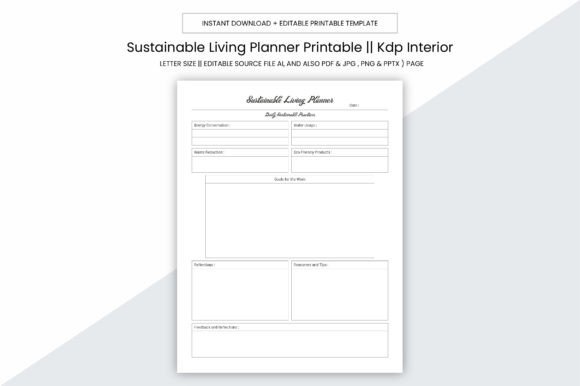
Sustainable Living Planner Kdp Interior
The Sustainable Living Planner Kdp Interior is not just another printable planner—it’s a purpose-built operational foundation for creators, small business owners, educators, and sustainability-focused professionals who need clarity, consistency, and control over how their message, systems, and offerings take shape. At 8.5 x 11 inches with no bleed, it fits standard printing workflows while preserving clean margins—critical when preparing interiors for Amazon KDP or local print-on-demand partners. Its 109-page PDF interior is pre-formatted to KDP specifications: 300 ppi resolution, CMYK-ready, and fully compatible with KDP’s upload requirements. But its real strategic value lies deeper—in how it structures intentionality into every page.
Why This Interior Works Where Others Fall Short
Most planners treat sustainability as a theme—not a system. The Sustainable Living Planner Kdp Interior treats it as both. It embeds decision-making frameworks directly into the layout: space for tracking personal carbon impact alongside business supply chain choices, habit logs that double as customer education tools, reflection prompts tied to circular economy principles. That integration matters because sustainability isn’t abstract—it’s operational. When you’re designing a planner for resale, each page must serve two audiences at once: the end user (who needs usability) and your brand (which needs coherence and authority).
This interior supports that duality. The editable source files—AI, PDF, JPG, PNG, and PPTX—allow you to adapt tone, color, icons, or terminology without redesigning from scratch. You can localize language for EU markets, add bilingual headers for bilingual communities, or swap illustrations to reflect regional ecosystems. That flexibility isn’t convenience—it’s strategic responsiveness. Markets evolve. Regulations shift. Consumer expectations deepen. A static interior locks you in; this one evolves with your positioning.
Practical Use Cases Across Roles
For KDP Publishers: Upload the 109-page PDF directly to KDP. No reformatting. No guesswork about gutter margins or bleed zones. The high-resolution, print-optimized interior means fewer rejection cycles—and faster time-to-market. Pair it with a custom cover designed for your niche (e.g., “Zero-Waste Families” or “Eco-Business Operations”) and you’ve built a scalable product line grounded in real utility—not trend-chasing.
For Educators & Coaches: Use the editable AI file to insert curriculum-aligned prompts—like calculating household water footprint or mapping ethical sourcing criteria. Print physical copies for workshops, then distribute digital versions with fillable fields for remote learners. The interior becomes part of your pedagogy, not just a prop.
For Small Business Owners: Repurpose pages as internal SOPs. Turn the “Monthly Sustainability Audit” spread into a vendor evaluation checklist. Convert the “Waste Reduction Tracker” into a team dashboard. Because the interior is editable and modular, it scales from personal reflection to operational documentation—without requiring new software or training.
Strategic Planning Starts With Layout
You don’t build a sustainable business—or life—by reacting. You do it by designing constraints that support better decisions. The Sustainable Living Planner Kdp Interior enforces those constraints through structure: weekly review pages that require reflection before planning, quarterly goal-setting spreads that link personal habits to business KPIs, resource trackers that surface hidden inefficiencies (e.g., recurring subscriptions you forgot to cancel). These aren’t decorative—they’re behavioral nudges calibrated to reduce cognitive load while increasing accountability.
Consider how you’d use the “Impact Log” section. If you’re launching an eco-product line, logging material choices, shipping methods, and packaging alternatives in real time creates a living archive—not just for compliance, but for storytelling. Later, you can excerpt verified entries into marketing copy, investor updates, or grant applications. That’s leverage: one input, multiple high-value outputs.
What to Consider Before You Commit
An interior this capable only delivers ROI if aligned with clear goals. Ask yourself: What outcome am I optimizing for? Is it speed-to-market? Brand differentiation? Customer retention? Educational depth? If your answer is vague (“more sales” or “better branding”), pause. The Sustainable Living Planner Kdp Interior amplifies intent—it doesn’t substitute for it.
Risk increases when used without context. For example, uploading the raw PDF to KDP without customizing cover copy, subtitle, or description leads to generic positioning. Buyers search for solutions—not categories. “Sustainable Living Planner” is too broad. “Sustainable Living Planner for Remote Teams Reducing Office Waste” is specific, searchable, and signals expertise. Similarly, using the editable files without auditing color contrast or font accessibility limits reach—especially among educators, older adults, or neurodiverse users.
Also consider scalability. If you plan to release multiple planner variants (e.g., seasonal editions, industry-specific versions), build naming conventions and layer organization into your AI file now. Label layers clearly (“Cover_Type”, “Page_042_Habit_Tracker”, “Footer_Sustainability_Cert”). Future you will thank present you when updating ten versions at once.
How to Use It Intentionally—Not Just Conveniently
Start with audit, not adaptation. Print three key spreads—Goal Setting, Weekly Review, and Impact Log—and use them manually for two weeks. Notice where friction arises: Are prompts too vague? Do you skip certain sections? Does the layout encourage reflection—or just checking boxes? That feedback loop informs smarter customization. Don’t edit to make it prettier. Edit to make it *used*.
Then, layer in your differentiators. Add your logo subtly in the footer. Insert a short “Why This Matters” note on the first planning spread—written in your voice, not generic wellness jargon. Embed QR codes linking to your free resource library or community forum. These small touches transform a functional interior into a branded experience—one that builds trust before the first sale.
Finally, track usage—not just downloads. If you’re selling digitally, monitor which editable formats get downloaded most (e.g., PPTX for coaches building slide decks, PNG for social media snippets). That data reveals unmet needs. Maybe users want Canva templates next—or Notion sync instructions. Let real behavior—not assumptions—guide your next iteration.
Long-Term Value Beyond the First Print Run
This interior earns long-term value because it’s built for iteration, not obsolescence. The editable source files mean you can update content annually—adding new metrics (like Scope 3 emissions tracking), integrating emerging frameworks (like the UN SDGs), or responding to regulatory changes (like EU EPR laws). That’s how you maintain relevance without constant reinvention.
It also supports ecosystem thinking. Use the same interior across offerings: a low-cost digital version for email list growth, a premium printed version with recycled paper for loyal customers, and a white-labeled version licensed to nonprofits or municipalities. Each variant shares core structure—but adapts messaging, pricing, and distribution to match audience readiness and capacity.
That kind of coherence builds authority. When your planner, workshop materials, and client onboarding all use aligned language and logic, people recognize your framework—not just your product. And frameworks outlive trends.
Final Thought: Tools Enable Strategy—They Don’t Replace It
The Sustainable Living Planner Kdp Interior is a high-fidelity instrument—not a shortcut. Its 300 ppi resolution ensures clarity. Its KDP-readiness saves hours. Its editable formats invite ownership. But none of that matters unless you anchor it in deliberate choices: Who are you serving? What problem are you solving—not describing? How will you measure whether this tool improved a real outcome?
Use it to clarify, not complicate. To simplify complexity, not add more steps. To connect daily action to larger purpose—without losing sight of either. That balance is rare. This interior makes it practical.