Genealogy Family History KDP Interior: Your All-in-One Template for Launching Meaningful, Low-Content Books on Amazon
If you’ve ever flipped through a beautifully bound family history journal at a local library—or watched a relative painstakingly fill out a handwritten ancestry chart—you know how powerful those quiet, personal records can be. Now imagine turning that same emotional resonance into a real, revenue-generating product on Amazon KDP—without writing a single sentence or hiring a designer. That’s exactly where the Genealogy Family History KDP Interior steps in: not as a generic notebook, but as a thoughtfully engineered, field-tested interior template built for creators who want to publish fast, print flawlessly, and serve real people searching for connection, clarity, and continuity.
What It Actually Is (Beyond the Buzzwords)
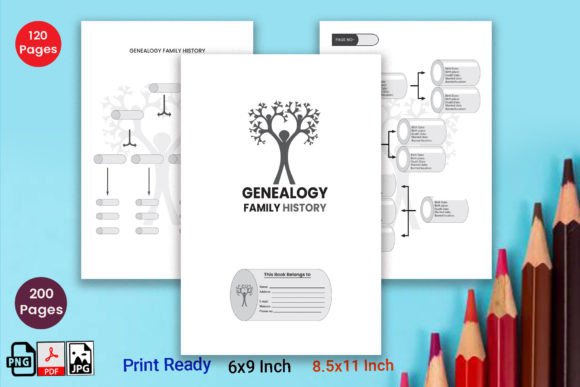
The Genealogy Family History KDP Interior is a ready-to-upload, vector-based PDF interior file designed specifically for Amazon KDP’s print-on-demand requirements. It’s not a blank page—it’s 120–200 pages of intentional structure: pedigree charts, family group sheets, timeline prompts, migration maps, photo caption spaces, and oral history interview guides—all laid out in clean, professional typography and scalable vector format. Because it’s built in Adobe Illustrator and delivered as an editable PDF, you’re not locked into one size or layout. Need a compact 6×9 journal for gift-giving? Done. Prefer an expansive 8.5×11 version for classroom use or senior center workshops? Just resize—no pixelation, no quality loss.
Real People, Real Moments Where This Template Makes a Difference
A genealogist launching her first digital course includes this interior as a bonus workbook. Students download the PDF, print it at home or a local shop, and start filling in names, dates, and stories *during* the lessons—not weeks later. No formatting headaches. No “I’ll get to it when I have time.” Just immediate, tactile engagement.
A small-town historical society uses the same template to create a limited-run “Our Founding Families” journal sold at their annual heritage fair. They swap in local landmarks for the default map placeholders, add their logo to the cover (using the included high-res PNG/JPG assets), and upload the interior in under 10 minutes. No designer on retainer. No minimum order. Just community pride, printed.
A homeschool parent adapts the timeline and immigration prompt pages into a living history unit for her 11-year-old. She prints two copies—one for her child, one for her own notes—and they interview Grandma together over Sunday lunch. The structure gives them focus; the clean design keeps distractions low.
A grief counselor recommends the journal to clients navigating loss. Pages dedicated to “What I Carry Forward,” “Voices I Still Hear,” and “Traditions I Want to Keep” offer gentle, non-clinical scaffolding for memory work—something many find more accessible than traditional therapy worksheets.
Who Benefits—and How Their Needs Shape Use
- First-time KDP publishers appreciate that it’s been “100 tested on Amazon KDP”—meaning margins, gutter spacing, font embedding, and bleed settings already comply with Amazon’s strict upload rules. You skip the rejection emails and reformatting loops.
- Family historians with niche audiences (e.g., African American lineages, Indigenous kinship mapping, adoptee search journals) use the editable layers to customize headings, add culturally specific symbols, or translate sections—keeping authenticity intact while scaling production.
- Educators and librarians rely on the no-bleed, print-ready files because they often print batches on campus copiers or partner with local print shops. No color shifts. No cropped borders. Just consistency.
- Creative entrepreneurs bundle it with Canva-designed covers or audio-guided storytelling prompts and sell it as a “Family Memory Kit”—turning one interior file into multiple income streams across platforms.
Things to Keep in Mind Before You Start
This isn’t magic—it’s a tool with thoughtful boundaries. Since it’s a low-content interior, it doesn’t include pre-filled data, AI-generated narratives, or automated research links. That’s by design: it leaves space for *your* voice, *your* audience’s needs, and *your* brand’s tone. If you’re hoping for plug-and-play content generation, look elsewhere. But if you value control, clarity, and compliance, this delivers.
Also worth noting: while the vector PDF is fully editable in Illustrator (and even opens cleanly in Affinity Designer or InDesign), basic edits—like changing font size or swapping a title—can be done in free tools like PDFescape or Acrobat Reader’s form editor. You don’t need a $30/month subscription to make meaningful tweaks.
And because it includes both JPG and PNG exports at 300 DPI, you can also use individual pages as social media graphics, workshop handouts, or printable PDFs for email lists—extending its utility far beyond KDP.
Why “Tested” Matters More Than You Think
“100 tested on Amazon KDP” isn’t just marketing speak—it reflects real-world friction points: inconsistent page counts causing auto-rejection, fonts failing to embed, grayscale images converting to muddy CMYK, or margins clipping headers during preview. This interior avoids all of that. It’s been uploaded, proofed, ordered as a physical copy, reviewed for spine alignment and paper feel—and refined. That means less guesswork, fewer do-overs, and faster time-to-sale. For someone juggling a full-time job or caregiving duties, that reliability isn’t convenient—it’s essential.
More Than a Template—A Bridge Between Past and Present
At its core, the Genealogy Family History KDP Interior meets a quiet but growing need: the desire to document, honor, and pass on what matters—without needing technical expertise or creative burnout. It works for the teenager scanning great-grandma’s letters on her phone and wanting to organize them. It works for the retired teacher compiling oral histories from her former students. It works for the immigrant parent translating family stories into English for her bilingual kids.
It doesn’t replace deep research—but it removes the barrier between discovery and documentation. And in a world where attention spans shrink and digital archives vanish, having a tangible, beautiful, Amazon-ready place to gather those fragments? That’s not just practical. It’s quietly revolutionary.